March 9, 2012

World's Science Day


Yesterday it was World’s Science Day. We have been investigating about the life cycles of butterfly, frog, bean and sunflower but since we got our chameleon our focus of inquiry shifted and for a good reason. It is fascinating to have a pet chameleon. We have been learning a lot about it. The students asked many questions and wondered about the life cycle of a chameleon and how to take care of chameleons. We found many answers in books and I complemented the research by looking up sites in the Internet. I have started a PowerPoint presentation with information that we have collected but we still have a few questions to answer.


The highlight is of course watching the chameleon feed. I am posting one clip of him feeding below. It is only 16 seconds but if you do not have very good Internet connection it takes some time for the video to upload. After you click on the play button be patient and wait a few seconds. You might need to clock again on the play button. Initially it looks like the screen is frozen but the video will play.


Chameleon feeding from Amelia Mello on Vimeo.


Back to World’s Science Day we watched what we have so far of the Power Point and we did a close observation of our chameleon and all students drew it. Then I asked the students what they could tell me about their chameleons.  Below are some of their journal entries.  The whole process of drawing the chameleon was fascinating as we were discovering shapes and different ways to draw it. One student said that the head of the chameleon looked like ‘capital letter D’ and he started that way. See if you can find who the student is. Even the younger ones did a great job.
 Chameleon by Cristobal
"Chameleons eat grasshoppers, butterflies, ants and flies." Delhem 

 "His tongue is big. He is eating this (and he pointed to his drawing of an insect)" Edvin
 "My chameleon has big eyes and a long tail. It has a long tongue to catch the grasshopper." Fredy

 Chameleon by Imani D
 "My chameleon is eating a grasshopper. The grasshopper was going to fly but the chameleon got it quickly." Marika
 "My chameleon is eating a grasshopper with his sticky tongue" Nina
 "My chameleon was looking for a grasshopper to eat. And he found one" Shose
 "It's (my chameleon) is green" Jemima (who just turned 3;0)
 Jelte likes chameleons

We will free the chameleon before the school year ends. By the way the chameleon was found crossing a road and Hannah’s mother stopped her car and rescued him. This type of chameleon is very common here in Tanzania.

Amelia Mello, M.Ed.

March 7, 2012

World's Math Day

Today is World's Math Day and we did a lot of Math activities.

We did many activities and I am going to show two of them, writing numbers and shapes.

In preparation for writing numbers on a paper we did counting, rote counting and singing. The students traced numbers on the seed tray, traced them also on the sand number card and finally they wrote the numbers using the colors of the rainbow. They have also done numbers with play dough, counters, dot-to-dot and many other ways but not today.


I made a worksheet for the students to trace the numbers . Repetition is key but it needs to be fun. Out of everything I tried the rainbow number worksheets is what the students liked the most and it is only one sheet of paper that you can use many times. You can ask the child to use one color per day but if the child is motivated you can let the child trace the numbers with as many colors as the child wants in one go. I made two templates. One with numbers from 1 to 5 and another that goes up to 10.

Click on the picture below to download the template 1-5 from MediaFire.

If you want to use the back of the page you can have the students trace dotted numbers.
Click on the picture to download the template from MediaFire.


Here is one example of the student work from the template 1 to 5.

I made a sand number card by gluing sand on the numbers on a colored cardboard. It works well. You can also cut the numbers on sandpaper.

Click on the image below to download the template 1 - 10 from MediaFire.
On the back of this paper you can have the children trace and copy numbers 1-10.
Click on the image below to download the template from MediaFire.

And one more sample of student work.
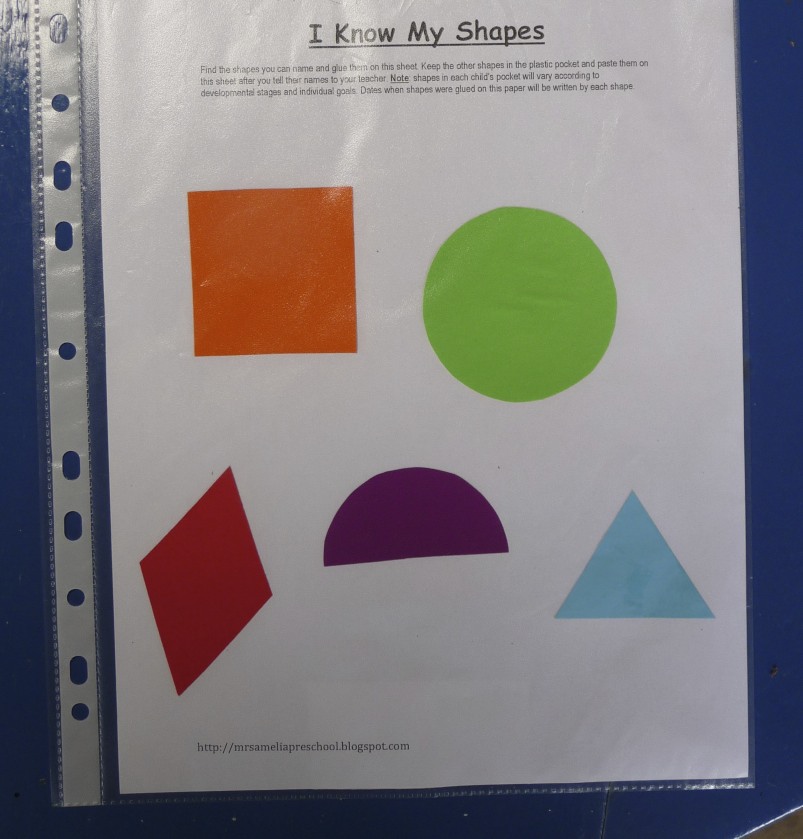
We also reviewed SHAPES!
And we recorded the shapes we know. This assessment is going to be placed in the students' portfolios.
I had the shapes pre cut and the students could choose which color they wanted and how they would place the shapes on the page.
Click on the image below to download the template from MediaFire.


If the child did know know all the shapes of their learning goal, we place the shape(s) the child did not know along with the sheet in a plastic pocket. In a month or two we can check again and if the child can name a shape then it can be pasted on the sheet.


I would also like to share an assessment that I did on counting and rote counting as this is one of the skills we usually work with preschoolers. This type of assessment allows you, the child and parents to see the child's progress in rote counting and counting objects from the beginning until the end of the school year. It is an idea for a portfolio entry.

I made this template if you are going to use dots. My students used the dot-to-dot markers for this assessment.
 I also made this template to be used with anything the child wants to count like fingerprints, cut shapes, seeds, etc.


Amelia Mello, M.Ed.

March 6, 2012

World's Spelling Day


Today it was World’s Spelling Day and EC wanted to join the rest of the school on this event. As this week we are investigating the letter T we spelled  words starting with T. We wrote them on the board and TV was one of them. The young children used wrote and drew TV in their journals. With that we also talked about shapes as TVs are mostly rectangles. Some even drew the remote control. Here are some examples below.


Older students chose to write words and I proposed using a worksheet that I call “Fabulous Four”, which I do not use frequently in EC but my students are so eager to write and are ready for some more structured work. They helped me spell the words on cards and then they copied the words form the cards. I did not limit them to words starting with T. Here are some samples.


Below is the template of the fabulous four worksheet. Just click on the picture to download it through Mediafire. I am sending it as a word document so you can modify it if you want.

March 3, 2012

Number Recognition Self-Assessment


I created these assessments to check the ability of a young child to recognize numbers randomly dispersed on a page. It is important that the numbers are not showed in order.

I use the same worksheet for pre-assessment and summative assessment as well. Once you see the worksheet you will understand how I can use it multiple times and how it shows student’s progress over time. I call it a self-assessment because the student is actively engaged in marking the page, receives immediate feedback and come out of the experience with a learning goal.

These Number Recognition Self-Assessments are great items for a Student Portfolio.

I created one assessment sheet for number recognition from 1 to 10 and another from 1 to 20.
You can download them both for free. Just click on the images below.


Assessment is a vital component in teaching. The first step in teaching is to have a teaching goal, an objective; what we want the students to know. Then we need to assess what the students already know, tailor the lessons/activities/learning engagements and finally we assess what the students have learned.

The Number Recognition Self Assessment that I created consists of the student looking at numbers out of sequence and saying their names. The student will color the numbers he knows and we celebrate his knowledge. I might say “Wow, look at all the numbers you already know, isn’t it great?” Even if the child knows only one number I can say, “Wow, you already know one of the numbers”. And if the child does not know any number I can say, “Wow, look at all the numbers you will learn in EC”.  The most important thing is to build the child’s confidence in his ability as a learner.

The numbers the student does not know are the learning goals for that particular student. The teacher plans activities to have the students practice number recognition. I tailored the activities according to students’ interests or according to what I think they will be intrigued about.

Amelia Mello, M.Ed.

March 2, 2012

Reading Behaviours


One of the most powerful tools in assessment is ‘observation’ and this is always a fascinating experience to me. I see so many things and behaviors that I would not observe otherwise.

Today I will talk about my observations of ‘reading behaviors’ in my Early Childhood class.

When I say reading behaviors I mean how children are interacting with print material.  For example, how children are handling books, if they seem engaged in looking at the book, if they are laughing at a funny illustration, if they are demonstrating story reading behaviors by talking as if they were reading the words and many others. There are many behaviors, but my goal is not to bore you by talking about them but to show some of them through pictures.

This boy was having a great time reading one of Spot’s books. He likes humorous books and it is a delight to hear him laugh heartily at some of the illustrations.
These children had free reading time and they chose to read non-fiction books. They were extremely engaged looking at the pictures and talking about what they were learning with the books.

Those two girls were working together to read three letter words. They worked collaboratively without my help until they finished the task, which took a significant amount of time for this age.


This boy was in the library and he just sat with his legs crossed like a like a grown up man. I am almost certain that this reading behavior is modeled to him at home and he picked it up and is unconsciously mimicking it, which is fabulous. I had to add the out of focus picture because he was reading a book about Jet Airliners, not the typical choice of book for a 4 year old.

During DEAR time (Drop Everything And Read) when we all sit with a book and read this darling boy was having what I defined as a ‘sensory’ reading of the book. He looked at the book the right way up, upside down, front to back, then back to front, smelled the book, brought it close to touch his face and finally he opened the book looked at the page and just ‘listened’ to it, for a while.  Isn’t it the most amazing thing?

I just love EC children! 

Amelia Mello, M.Ed.